Pilani, Jhunjhunu District, Rajasthan
Pilani
A Study into the Lac Bangle Craft of the Shekhawati Region
An examination of lac bangle craft as a prospective vehicle of rural livelihood generation in Pilani and the surrounding Shekhawati region.
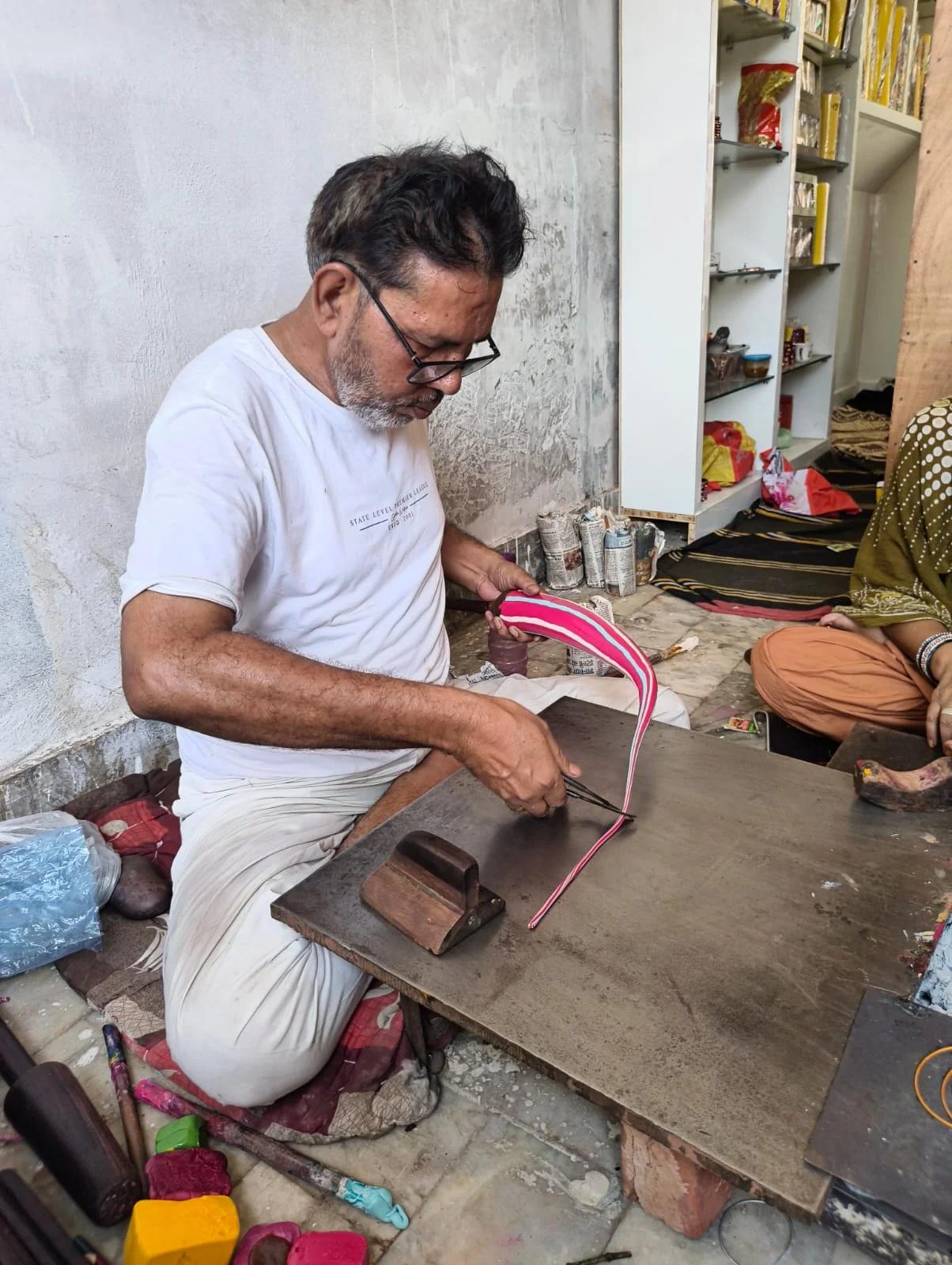
The Lac Bangle Craft: Material Foundations and Technique
Lac, the raw material from which the craft proceeds, is a resinous secretion produced by the insect Kerria lacca as it colonises the branches of host trees, most notably kusum, ber, and palash. The purified lac is heated with careful attention to temperature, softening into a pliable mass into which natural or mineral pigments are worked to achieve the vivid colour for which the craft is celebrated.
The Taxonomy of Form: Shapes, Sizes, and Designs
The classic circular bangle remains the tradition's most recognisable form, yet the craft accommodates considerable elaboration: the kada, a broader cuff-like variant; the segmented or hinged bangle, permitting ease of wear; and tapering or graduated styles. Sizing is also a primary point of market differentiation.
Labour, Gender, and Household Economics
Lac bangle making has historically been associated in Jaipur with the Manihar and Lakhera communities and organised along family-workshop lines. A new Pilani initiative need not reproduce that precise division of labour: the short production cycle and modest equipment needs make the craft adaptable to a household-based, women-led production model.
Findings
The sustainability of a Pilani-based lac bangle venture depends substantially on a raw-material supply chain over which local production has little direct control. At the same time, the market for lac bangles is broader than that for many regional handicrafts.
Opportunities
Potential next steps include primary fieldwork, a pilot cohort of Pilani-based practitioners, a cooperative or self-help group structure modelled on the Ambuja Agency precedent, and exploration of host-tree cultivation on village common land.